

Living in multi-level homes has become the norm across major Canadian cities, and this shift is driving strong demand for safe and reliable residential mobility solutions. A Home Elevator is no longer viewed as a luxury upgrade alone but as a practical lifestyle investment that supports long-term comfort, accessibility, and property value. With advanced pneumatic technology, compact structural requirements, and energy-efficient operation, home elevators in Canada are now accessible to a much broader range of homeowners. This guide explores home elevators’ cost in 2026, price-influencing factors, technical specifications, and what Canadian buyers should expect from a modern Home Elevator system.
Why Home Elevators in Canada Are Gaining Rapid Popularity
Home elevators in Canada are becoming popular due to changing family structures, aging-in-place needs, and increased focus on accessibility. Seniors prefer homes that support independent movement across floors, while younger families want smart solutions that future-proof their residences. Nibav Home Elevators use self-supporting hybrid shaft structures that require no pit and no machine room. With a minimum base footprint of approximately 1010 mm and internal cabin diameters reaching up to 1160 mm for wheelchair access, these Home Elevator systems integrate easily into modern Canadian homes without major structural modification.
Average Home Elevator Cost in Canada for 2026
The estimated home elevators cost in Canada for 2026 ranges between CAD 65,000 and CAD 124,500, depending on the selected model and level of customization. Entry-level Home Elevator models, such as Series III, typically fall in the lower range, while premium models like Series IV Max with smart control panels and advanced safety features fall toward the upper price band. These models generally support 210 kg to 240 kg load capacity, offer G plus 3 floor travel, provide 805 mm door openings for wheelchair accessibility, and include automatic emergency descent during power failure for safety.
Key Technical Factors That Determine Home Elevator Price
The first major factor influencing home elevator price is load capacity. A 210 kg Home Elevator is suitable for two passengers, while a 240 kg model is designed for wheelchair compatibility. The second factor is travel height, with Nibav Home Elevators supporting vertical travel up to 13,500 mm. The third factor is structural design. Self supported Home Elevator systems eliminate the need for pit excavation and reduce civil construction costs significantly. Features such as panoramic polycarbonate glass cabins, touch screen controls, GSM cabin phones, and smart automation also impact final pricing.
Technology Behind Pneumatic Home Elevators in Canada
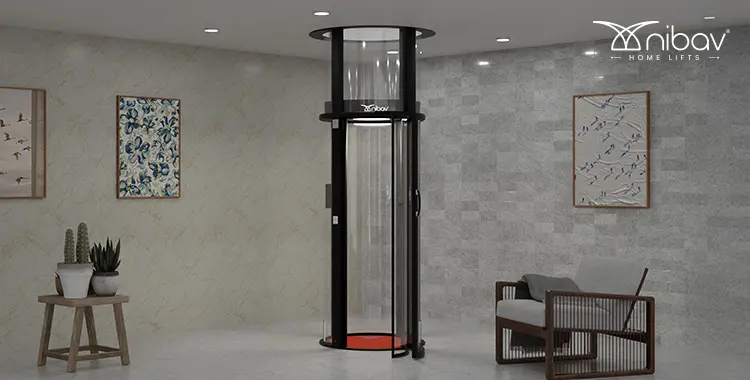
Nibav Home Elevators operate using advanced air-driven pneumatic vacuum technology. The cylindrical elevator cabin moves within a vertical polycarbonate shaft where controlled air pressure enables smooth ascent. The turbines responsible for regulating air pressure are mounted at the top of the structure. During descent, gravity controls movement while air pressure stabilizes speed. These Home Elevator systems consume approximately 3.7 kVA of electricity during ascent and zero energy during descent. The gearless and greaseless mechanism eliminates hydraulic oil and ensures vibration-free travel.
Energy Efficiency and Operating Cost of Home Elevators
Energy efficiency plays a crucial role in long-term home elevators’ cost. Nibav Home Elevator systems operate on a standard single-phase electrical supply that is widely available in Canadian residences. Since power is only consumed during ascent and not during descent, the overall electricity usage remains extremely low. The absence of oil, grease, counterweights, and hydraulic pumps also reduces mechanical losses. Over a ten-year ownership period, pneumatic Home Elevator systems deliver substantial savings in operating expenses compared to conventional electric and hydraulic elevators.
Safety Certifications That Influence Home Elevator Pricing
Safety standards significantly affect home elevator price and buyer confidence. All Nibav Home Elevators in Canada are manufactured under ISO 9001 quality management certification and are approved by TÃœV NORD. Each Home Elevator includes dual hardened safety brakes, dual electric and electronic door locks, emergency alarm systems, GSM-enabled cabin telephones, child safety switches, smart overload protection, and an automatic emergency descent feature. The cabin structure uses polycarbonate glass that is up to 250 times stronger than standard glass for enhanced passenger safety.
Cabin Dimensions and Space Requirements
Cabin size directly influences home elevators in Canada. Compact Home Elevator models feature internal cabin diameters of around 749 mm, while wheelchair ready models extend up to 1160 mm. External shaft diameters can reach up to 1343 mm, depending on the model. The minimum ceiling height required ranges between 2436 mm and 2460 mm. Door openings of 805 mm provide full wheelchair compliance and improve long-term accessibility. These compact space requirements make Home Elevator installations feasible even in smaller Canadian homes and townhouses.
Customization Options That Impact Home Elevator Price
Customization affects the final home elevator price more than any other factor. Nibav offers carpet interiors, leather cabin finishes, hydro dipped exterior surfaces, metallic textures, and designer color options. Cabin ceilings with concealed ambient lighting and touch control panels add both function and visual appeal. Additional upgrades like automatic return to pre-programmed floors, smart overload alerts through digital monitoring, GSM phone connectivity, and IoT-ready controls further increase system capabilities. Regardless of customization level, all models retain air-driven operation and G plus 3 stop capability.
Installation Cost and Time in Canada
Installation plays a major role in home elevators’ cost, and Nibav minimizes this impact through modular CKD-supplied structures. These systems arrive in semi-assembled sections and allow completion of installation within 3-5 working days. Since the lift is self-supporting, there is no pit excavation, no machine room construction, and no load-bearing wall required. Certified Nibav technicians complete structural anchoring, precision leveling, electrical integration using single-phase supply, and sealing processes with minimal disruption.
Maintenance Cost of Home Elevators in Canada
Long-term ownership cost depends heavily on maintenance requirements. Pneumatic Home Elevators require significantly less servicing than hydraulic systems. Since Nibav Home Elevators use no oil, pistons, or grease, maintenance mainly focuses on inspecting turbines, replacing rubber seals when required, calibrating door sensors, and testing brakes annually. Precision landing levers and silent mainboard systems reduce wear and extend operating life. This ensures that annual maintenance costs remain predictable and affordable across the system’s lifespan.
Smart Features That Add Value to Home Elevators
Smart automation features now play an important role in home elevator prices. Premium Nibav models include touch screen cabin panels, automatic return to home floor, GSM phone integration, soft start and stop algorithms, and silent digital control boards. Optional smart access control adds another layer of operational safety. These features operate on low-voltage digital control boards powered by a standard single-phase supply. Smart functionality improves ride comfort, safety monitoring, and overall ownership experience.
Wheelchair Accessibility and Its Impact on Cost
Wheelchair ready Home Elevator models typically cost more due to increased cabin dimensions and higher load capacity. Nibav Series III Max and Series IV Max models offer 240 kg capacity, 1160 mm internal cabin diameter, and 805 mm clear door opening. These specifications allow smooth wheelchair entry, interior turning, and safe exit at every floor. Precision landing systems ensure accurate leveling at each stop, which is critical for wheelchair safety. These accessibility enhancements increase cost but deliver unmatched long-term value.
Property Value Benefits of Installing a Home Elevator
Installing a Home Elevator has a direct positive impact on resale value in the Canadian property market. Homes equipped with G plus 3 stop pneumatic Home Elevator systems attract more buyer interest, particularly in urban townhomes and senior-friendly communities. ISO 9001 and TÃœV NORD certifications further strengthen buyer confidence by demonstrating international safety compliance. Real estate professionals consistently report that modern Home Elevator installations improve long-term marketability and future proof multi level properties.
Home Elevator Pricing Comparison by Model Category
Entry-level Home Elevator models with 210 kg load capacity and 749 mm cabin diameter form the base pricing category. Mid-range Home Elevator models with 240 kg capacity and wider panoramic glass cabins sit in the moderate price range. Premium Home Elevator systems with GSM telephones, touch screen controls, dual door access, and IoT smart connectivity fall into the high-end pricing segment. Across all categories, Nibav maintains air-driven operation, single-phase electrical supply, zero energy descent, and pit-free installation design.
2026 Outlook for Home Elevator Cost in Canada
The home elevators cost outlook for Canada in 2026 indicates continued market stability due to modular production processes, faster installation techniques, and improved component sourcing. Increased adoption across residential townhomes and villas will further normalize Home Elevator ownership. Smart automation, wheelchair accessibility, and eco-friendly performance will remain the dominant price-influencing factors for Canadian buyers moving forward.
Final Thoughts on Home Elevator Price in Canada
A Home Elevator today represents far more than a luxury upgrade. It is a long-term accessibility solution that delivers safety, comfort, energy efficiency, and increased property value. When evaluating home elevator prices, Canadian homeowners should assess safety certification, power consumption, cabin dimensions, installation process, and long-term durability rather than focusing solely on upfront cost. With ISO 9001 certification, TÃœV NORD approval, air-driven pneumatic operation, self-supporting structures, and G plus 3 stop capability, Nibav Home Elevators stand among the most advanced residential mobility systems available in Canada today.